
Processing Emotions Through Cinema
Grieving through film

The first time I saw The Farewell (2019) was on a flight to visit my family in the States, a few days after my 24th birthday. Moving to London at 23 felt like such a thrust into adulthood that I had forgotten time still passed at home. My friends had gotten new jobs, my sister was halfway through medical school, and I had missed birthdays, graduations, and sleepovers. Each conversation gave me the opportunity to share the life I was creating for myself, while reconciling with everything that life required me to leave behind.
The second time I saw The Farewell was a few weeks after a career high, and the day my grandmother was diagnosed with dementia. Like the film, we thought not disclosing the extent of her illness would protect her final days from the fear of what the illness would bring. However, eventually, she realized that her mind was deteriorating, and despite her remembering her loved ones, she forgot and lost the ability to do nearly everything else.
And most recently, I revisited the film a week ago after the death of my grandmother. It was different this time, and the feelings it brought were more complicated. There was the obvious grief, but also the sadness of wishing we were closer. I had a complicated relationship with my grandmother, and by the time I became an adult, we barely spoke. I left my hometown and didn’t look back. I called on holidays and birthdays and avoided long interactions and sentimental conversations. I didn’t grow up with a grandmother who baked cookies and spoiled me, but rather one who could be harsh, judgmental, and whose love was not always evident in her actions. As a child, I looked through a lens of optimism in our relationship, but as an adult, I saw the reality. My self-imposed isolation felt like protection, but suddenly I began to question it as I realized how few memories I had left.
And as I found myself writing my grandmother’s obituary rather than a weekly Substack, all I wanted to do was watch films. With my emotional support blankets that cover my walls with shadows in the dark, I turned to cinema to process the complexity of my grief. I watched Tiny Furniture (2010) and remembered that every woman in my family has also been a young woman wondering which direction to take her life, but also fearing each direction and the unknown. I felt the piercing ache of realizing an entire generation of my family no longer exists in this realm, and wondered what wisdom had died with them.
And I found comfort in the camp fashion dramedy Idiotka (2025). The film, which follows a disgraced designer on a reality fashion television show as she tries to win the money to save her grandmother’s apartment, made me feel more connected to the generational possessions left behind. Though my life is far away from my hometown, it feels comforting to know that four generations of women have planted flowers and run through the same yard.
I watched The Worst Person in the World (2021) and cried at the scene depicting the state of the lives of generations of women in Julie’s family at her age. At my age, my grandmother already had four children, and I thankfully have none. I felt the pang of awareness that my ability to be who I am came from my grandmother having my mother at 18 and raising children without a fully developed frontal lobe.
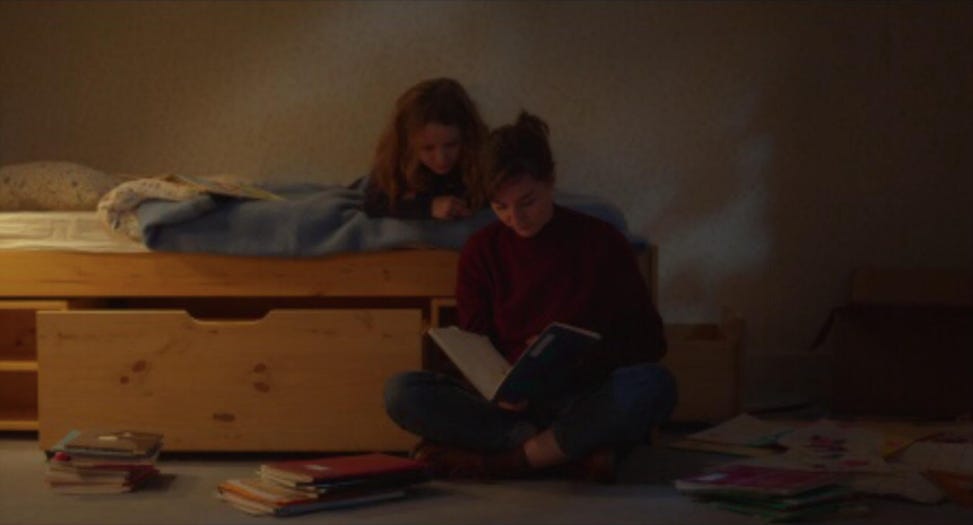
I watched Petite Maman (2021), and it felt different than the first time I watched it. Now, I was the little girl helping my mother go through my deceased grandmother’s belongings. I was a grieving child, but I was also my mother’s confidant up at night helping her write her mother’s obituary. The film felt more precious this time. How great must it be to go back in time to be the friend your mother needed? I wondered what it would be like to see my grandmother full of life as a young mother, and be explore the neighborhood my mother always describes with such nostalgia and excitement with her. But I also realized what a privilege it is to support the person who has always supported you when you’re the adult, and somehow still the child at the same time.
Grief is so confusing, but cinema is company and a friend who offers perspective and empathy.
beautiful
This was heartbreaking and relatable. I think my favorite thing about cinema is its ability to make us feel a little less alone, a little more insightful. I remember crying like a baby while watching The Worst Person In The World because I was mourning a relationship that I killed in the name of 'what if'. It was as cathartic as it was tragic. Thanks for the post, condolences for your loss.